You are reading the Suffering series
SufferingSeries
Published on: 02/10/2026
Explorations on the nature and purpose of suffering.
Suffering. It's a word that carries weight, isn't it? Not the kind we chase or celebrate, but the kind that finds us in the quiet moments, in the cracks of our carefully constructed lives. I've wrestled with it—tried to outrun it, numb it, explain it away. But suffering isn't optional in this broken world. It's the shadow cast by separation from God, a reminder that things aren't as they should be.
Yet, in the Christian walk, suffering takes on a different shape. It's not meaningless pain; it's the forge where character is shaped, where faith deepens, where we glimpse the hope of redemption. Here, in these meditations on suffering, we'll explore its many faces—from the betrayals that wound us to the disciplines we choose, from physical aches to spiritual droughts. We'll look to Christ's example, who suffered beyond measure, and ask: how does our suffering unite us with Him? How does it point us toward a future where sorrow is swallowed by glory?
These reflections aren't about glorifying pain, but about embracing it as part of the journey. Because if He suffered, why would we not?
Why would I not suffer?
Published on: 02/10/2026
A Christian perspective on embracing suffering as part of faith.
Why would I not suffer?
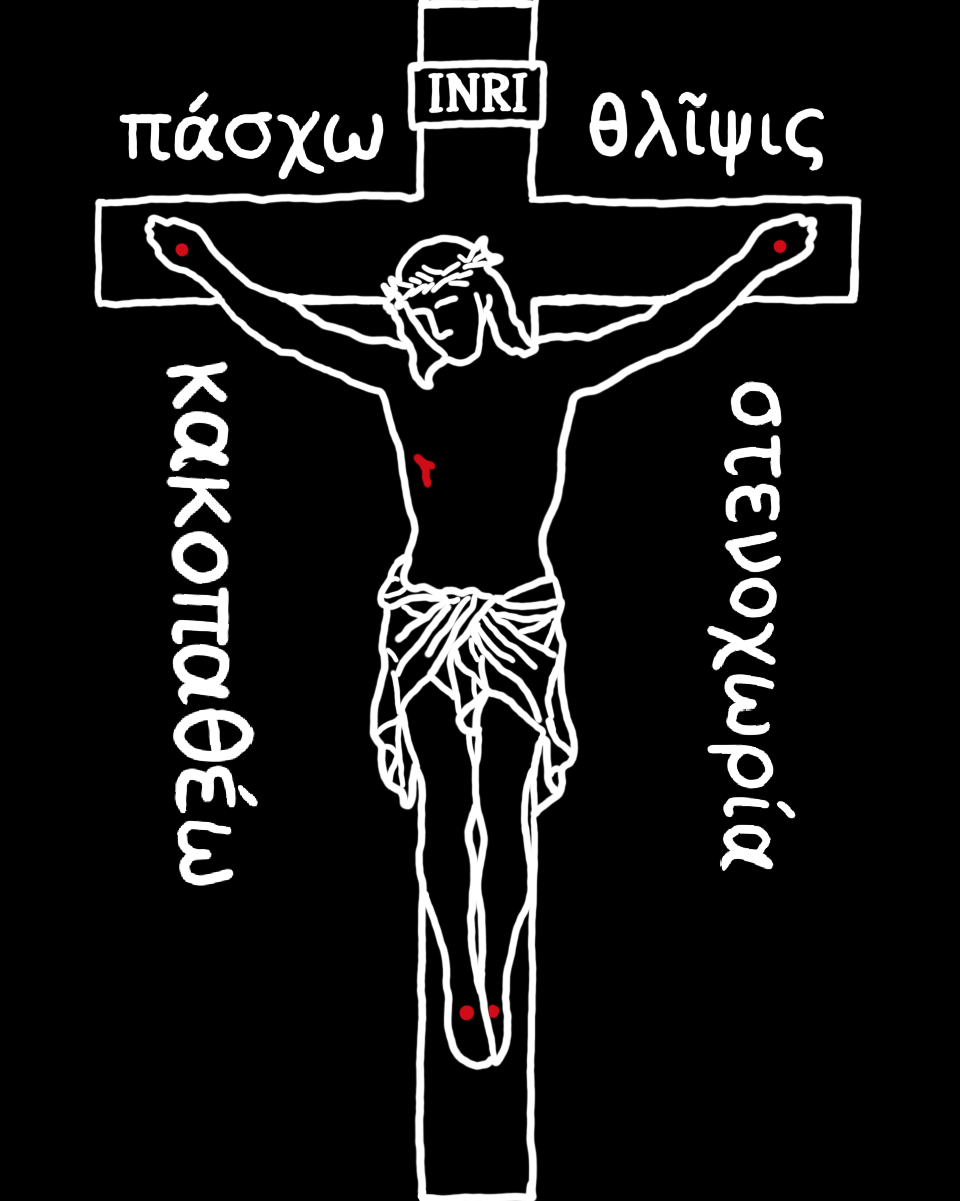
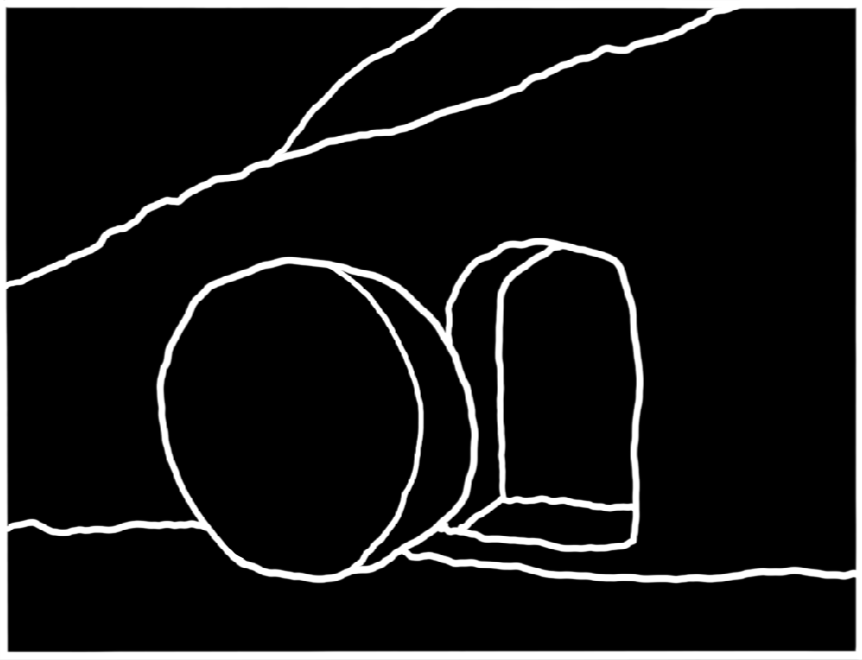
This question has been on my mind lately, so much so its inspired some art that I've attached below.
It's not that I believe that, in some pessimistic, sadistic, or masochistic view
that suffering is hopeless, gratifying, or good. Contrarily, I view suffering as the
consequence of separation from God. It isn't even implicitly good.
When God created us, it wasn't even in His original design. God
didn't intend for us to suffer.
If suffering is not good, then why must I suffer? There are
many who would say,
It's not necessary that you suffer.
Suffering is a product of your worldview.
Sin isn't real; it's an arbitrary assignment of evil based on archaic precepts.
I imagine there are a handful or more of other reasons that we
could explain away the reality of suffering, whitewash it into
comfort zones of the mind, or even ignore it entirely.
Believe me, I've tried to ignore my suffering many times throughout my life. I've tried to pleasure it away.
I've tried (unwittingly) insomnia, binge-eating, alcohol, hyper-caffeination to
then fix the insomnia, and some the combination of all of the above.
I realize now why people decide to live those lifestyles on repeat. Here's a hint for you:
It's much easier to reach for comfort than it is to fix the root case.
That's how the cycle works. You already know the pattern. You've
lived it. The bar, the bottle, the screen, the binge, the purchase,
the scroll, the swipe — whatever your fix is. You hit it, and for
a moment, the noise quiets down, if you're lucky. Then you wake up the next morning
and the silence is deafening.
So what do you do? You go back. You bring people with you this
time, because misery doesn't just love company — it requires it.
You need witnesses. Not to your joy, but to the performance of it.
We're having a great time, right? This is fun, isn't it?... right?
You scan the room. You're looking for someone to nod. Someone
to agree that this is working. And here's the tragic, ironic part —
so is everyone else. Every single person in that room is doing
the exact same thing you are: looking for someone to validate
the lie they already know isn't true.
You know it's not working. You knew before you showed up. You
knew when you grabbed your keys. You knew when you told yourself
this time will be different. It's never different. You keep
pouring from the same empty cup and then wonder why you're still thirsty.
It sucks admitting that a fulfilling life is built on top of discomfort.
It's so much more fun to focus on the easy things; defer the hard things
for later. Does that mean suffering is prioritizing the things that we
keep deferring?
I can't prescribe a singular definition to what suffering is. It would
be selfish of me to do so. Suffering for me looks like avoiding the things
that I know would be good for me:
- Exercise
- Healthy eating
- Waking up early
- Going to bed early
- Reading more books
- Learning something new
- Reading my Bible more
I'm being incredibly transparent with you. These are the things that
I consistently find myself procrastinating on. Have you taken
stock lately of the things that you're deferring?
Conversely, here are the things that I'm excelling at prioritizing:
- Playing video games
- Doom scrolling on my phone
- Eating processed foods and copious amounts of sugar
- Not drinking enough water
- Being sedentary
Does my list look like yours?
What's interesting is that every time I prioritize the
things in that defer list, I always end up feeling accomplished,
feeling aligned with what God designed for my body, mind, and spirit,
and feeling recharged.
Suffering is a universal truth only validated by the extent
and lengths that people will go to invalidate, ignore, whitewash,
and defer it. The daily repetitions of things that should
fix the disease only add onto it.
I look to the example of Christ who suffered. He suffered in ways that
I simply cannot. Suffering as a Christian acknowledges the presence of
suffering, but does not view it as hopeless. Contrarily, suffering enlightens us
to the hope of the future. Suffering aligns us to the righteousness of Christ.
If Christ suffered, why wouldn't we? I love framing it this way because it makes me
feel close to Christ.
| Human Experience of Suffering | Suffering That Finds You | Suffering You Choose |
|---|---|---|
| Anxiety and inner turmoil | Depression, existential dread, feeling like life has no meaning | Meditation, therapy, sitting with uncomfortable emotions rather than numbing |
| Betrayal | A friend or partner breaks your trust, someone you counted on sells you out | Choosing to be vulnerable again, extending trust despite past wounds, __forgiveness__ |
| Abandonment | Loneliness, isolation, facing hard things alone | Solitude, stepping away from distraction and noise to know yourself, and find closeness with your Heavenly Father |
| Being let down by people close to you | Those who should have your back disappoint you or stay silent | Showing up consistently even when no one notices or reciprocates |
| False accusation | Your reputation is damaged, you're misunderstood, motives questioned | Speaking truth when it's costly, refusing to spin or manipulate |
| Rejection by your own community | Family, colleagues, or friends exclude you for being different | Choosing integrity over belonging, staying true to your values |
| Physical pain | Illness, injury, chronic pain, aging, disability | Exercise, disciplined eating, pushing your body even in discomfort |
| Humiliation | Public failure, being mocked, shame exposed | Embracing humility, accepting feedback, letting go of image management |
| Bearing burdens visibly | Struggling in public, others seeing your mess | Serving others at personal cost, helping without recognition |
| Injustice | Systems fail you, power is abused, there's no recourse | Submitting to process even when it's broken, trusting that fairness will come, even if it's on the other side of this life |
| Deprivation | Poverty, lack, unmet needs, wanting what you can't have | Fasting, minimalism, living with less than you could, delaying gratification |
| Unanswered questions | Silence when you need answers, uncertainty, not knowing why | Sitting with ambiguity, continuing to show up without guarantees |
| Temptation to quit | Pressure to compromise, take shortcuts, abandon your principles | Self-control, saying no to what you want now for what you want most |
| Forgiving those who hurt you | Absorbing the cost of someone else's wrong without revenge | Generosity, giving without expecting return, releasing resentment |
| Mortality | Grief, loss, facing your own death | Letting go of control, accepting limitation, making peace with finitude |
| Waiting in obscurity | Feeling unseen, stuck, like nothing is happening | Rest, patience, trusting the process during seasons of hiddenness |
Christ-like suffering is acknowledging that the complex range of adversity in
life exists. It's choosing to align your mind, body, and spirit with the
choices that reflect the righteousness of Christ, not selling your soul
to alcohol, substance, food, addiction, sexual immorality, or any combination
thereof, or making idols.
The main thing that differentiates my response to suffering today in
comparison with that of the past is that I now embrace it. When I embrace
suffering as the necessary consequence of living in a broken world, I can
then look forward to a time when it will not be so. I can do that because
I trust God's promises.
But rejoice insofar as you share Christ’s sufferings, that you may also rejoice and be glad when his glory is revealed.
Suffering is not something to be avoided. It unifies you with Christ.
It is only good inasmuch as it enlightens me to the promises of the
future so that I don't become addicted, beholden, and a slave to the
present, and so I don't make idols of the useless things in this world.
But whatever gain I had, I counted as loss for the sake of Christ. Indeed, I count everything as loss because of the surpassing worth of knowing Christ Jesus my Lord. For his sake I have suffered the loss of all things and count them as rubbish, in order that I may gain Christ and be found in him, not having a righteousness of my own that comes from the law, but that which comes through faith in Christ, the righteousness from God that depends on faith— that I may know him and the power of his resurrection, and may share his sufferings, becoming like him in his death, that by any means possible I may attain the resurrection from the dead.
If He suffered, why would I not suffer?
End of Entry 1 of 2
A Blank Slate
Published on: 03/14/2026
A meditation on how to integrate pain and suffering through vulnerability, forgiveness, and Christian hope to lead an impactful life through your testimony.
A few extremely difficult spots in my life comprise my testimony, and
certain shared difficulties with my wife add nuance. I'm working on collecting
my thoughts to accurately convey all that God has done in my life. Perhaps
that's what these meditations are for. At a minimum, they'll help me gather
the details into a cohesive story. Nonetheless, I write these meditations because
in the wake of those life-altering changes and challenges, I have strived to
understand how to integrate these things into my life in a way that I can
make sense of the suffering. I think what I really want to know is if all this
pain and suffering can strengthen both me and others. I wonder if we're
all just trying to figure out how our stories intertwine.
Catalyzing On Change
When something life-changing, or really difficult happens in our lives, we have
an opportunity in front of us to wipe the slate clean. We can treat it as a moment
where we shed our old skin and grow new skin. Sometimes, in the presence of challenges,
it can feel tempting to go the other way. To pull back and hide away. Internalizing
pain and suffering — suppressing the opportunity to integrate it into our lives —
can feel right in the moment. That pain and suffering is raw and it's real. Reflecting
on it can act as salt to the wound instead of healing it.
I pushed my pain and suffering inside for a while. I was embarrassed about the
self-inflicted wounds I had caused myself. I didn't think people would understand, and
I thought people would pile on insult to injury. There was real suffering and mental
anguish that led up to the choices I made that caused me to languish. Those choices
felt right at the time. They helped me escape the real mental struggles I was facing.
Sadly, those same choices that were my escape caused a new kind of hell for me, and caused
a life-change in me that was significantly worse than the thing I was trying to avoid. Indeed,
that, I suppose, is the irony. In an effort to avoid struggles and suffering, a new
suffering is borne of it.
The story doesn't end there, thankfully. Finding meaning in pain and suffering isn't
intentionally or arbitrarily assigning value to that pain and suffering. It's a serious
introspection on the things that caused you suffering. It's taking the circumstances,
the actions, people, places, times, and everything else in those moments of pain and
reflecting on the story that you can tell others about it. There is most definitely a story.
When those things are happening to you, you feel like you're alone in it. The truth is that
your pain and your suffering are aligned with so many more people than you realize. Integrating
that suffering into your life isn't about erasing it. It's about figuring out how you can
take that story that has been woven into your life and helping others make sense of their
circumstances. Many people are still in theirs. If you escaped yours, and you are on the
other side of it, congratulations! You have a story to tell.
That story might be what pushes people to hope for a better day. It might be all it takes
to give someone the strength to persevere for another tomorrow. Your story has value, not
simply because it's relatable, but because it unifies you with other people that need to
know they're not alone. Presence is way more valuable than you might think. Listening from
a place of understanding has real power. A struggling brother or sister knowing that someone
understands and is actively listening is strengthened just by knowing someone gets them.
Your meaning of your story doesn't have to be grandiose, and it certainly doesn't have to
be the next motivational, self-help book on the shelves. But, in order for your story
to have impact, you have to be vulnerable.
Extreme Vulnerability
Vulnerability is power over your circumstances. It gives you agency over the suffering
and pain that you went through. In the moments of vulnerability where you share in the
suffering of others, and you tell people, "I get you," you tell people that:
- Their circumstances aren't final.
- There's no shame in pain and suffering no matter if it's self-inflicted or not.
- Pain and suffering are universal truths. Nobody gets out alive.
- Someone out there understands you and made it out.
- Your pain and suffering will help someone one day.
Yes, vulnerability is an incredibly powerful tool — and I encourage you to look at
it as a tool. Hiding your pain and suffering is usually a result of one of those five
things above. You feel your circumstances are final, or you're ashamed, or that pain
and suffering are unique to you, or that no one understands your particular flavor of
pain, or that your pain and suffering are too different, too dark, twisted, or deep
to make sense of.
Dear reader, I want you to know that none of those things are true. If you're feeling
that way, I don't want to preach to you. Those feelings are real, and you're at war
with yourself. But, don't make the mistake of seeing these things as strictly chemical
imbalances and misfiring neurons. No, you're at war with evil, with an enemy that is
spiritual. He has convinced you that you are irreparable, you are a failure, or that
you're too different for someone to understand. That's how he works — through isolation. He wants you alone, silent, ashamed, and
defeated. He knows that it is in those places that he can destroy your life.
So, how do you defeat that enemy? It really does start with extreme vulnerability.
Open up to a trusted friend, or loved one. If that's not safe, open up to a therapist.
You must learn to integrate this pain and suffering in your life into a story that
you own. Integrating pain and suffering doesn't mean that the pain and suffering disappears.
I think that's where many people get that wrong. They think that pain and suffering
should be wiped away from the slate, and erased from the record. Friend, let me tell you
this. Pain and suffering, integrated correctly, become a scar that people ask you about. It's a
deep empathy that says to those around you, "I've been there, too." It becomes a medallion
around our neck, a trophy on the shelf, or a piece of artwork on the wall that visitors
ask about. Conversely, poorly integrated pain and suffering become battle armor hiding in
the deepest, darkest corners of our closet, buried under mounds of other things we'd
rather people see first.
Forgiveness
Finally, friends, I want you to understand that integrating pain and suffering
into our lives and making sense of it always involves forgiveness.
Maybe your pain and suffering weren't self-inflicted like mine. Maybe it was
inflicted by someone else. I'll never forget the day that I forgave myself. It was
2024, and I was sitting outside with a trusted friend. We were talking about the
pain that I had caused myself. I was still talking about it with anger and self-loathing.
I was so mad at myself. I broke my body and left it with permanent consequences. My eyesight
was never coming back, and I had scotomas in both of my eyes.
Then, my friend asked me to pray that I could forgive myself. We were sitting outside. The
weather was fresh. It must have been autumn because it was comfortable. Outside, I closed
my eyes. I prayed to God with anger on my lips. I was so full of hate for myself. For two years, my entire existence had been focused
on punishing myself for the sins of the past. I had done a pretty good job of it, too.
I lost 90 lbs through starvation dieting, punishing exercise — jump rope, running —
extreme intermittent fasting, and ruthless self-talk in the mirror. Then, God gave me a vision. It was nine- or ten-year-old me.
Only, I was looking down at him, and he was looking up at me. It was that look that, if you're
a parent, you understand. That feeling of remorse that children show when they're sorry for what
they've done. He was looking at me asking for approval, love, acceptance, and forgiveness.
I wept.
As I'm sitting here recalling that day, I have tears in my eyes. That vision was so vivid.
I'm familiar with that look in a child's eyes. I have children of my own. Children want
gentleness when they've done something wrong, and they want to know that everything is going
to be okay. That's my approach in parenting. I have an incredible amount of patience with my
kids. It puzzled me, then, why I couldn't show that to myself.
So I chose to. From that day forward, and with my friend there, I chose to forgive myself.
I forgave myself in the deepest way — so deeply that I now understand why my heart was
broken when I was avoiding hardship and suppressing it in unhealthy ways. The integration is
complete. The slate was wiped. Not clean — not like it never happened — but
clear enough to write something new. The things that I have done to myself are
part of my story. In fact, I can tell you that I fully love the brokenness of
my body because it is through that brokenness that I can lead by example to
others that are also broken. I'm still broken, but I can navigate it in
healthier ways. I navigate it through a lens of understanding, gentleness,
and forgiveness. I don't always get it right, and I won't pretend that I will.
The most important truth that I can tell you today is that you don't need to wait for forgiveness.
You don't need to wait to forgive others. We have a savior in Christ who led the way for us.
He wants you to know that His strength is perfected in your weakness. He died for you and me,
and forgave you and me while we were still sinners. You are forgiven! If you're still living
in the shadow of your shame, or you're not sure how to integrate your suffering into your life,
start with extreme vulnerability. Open up to a trusted friend or therapist. Begin the healing
journey so you can forgive yourself or others. Jesus loved you enough to forgive you. Now,
you just need to follow Christ's example and take the first step.
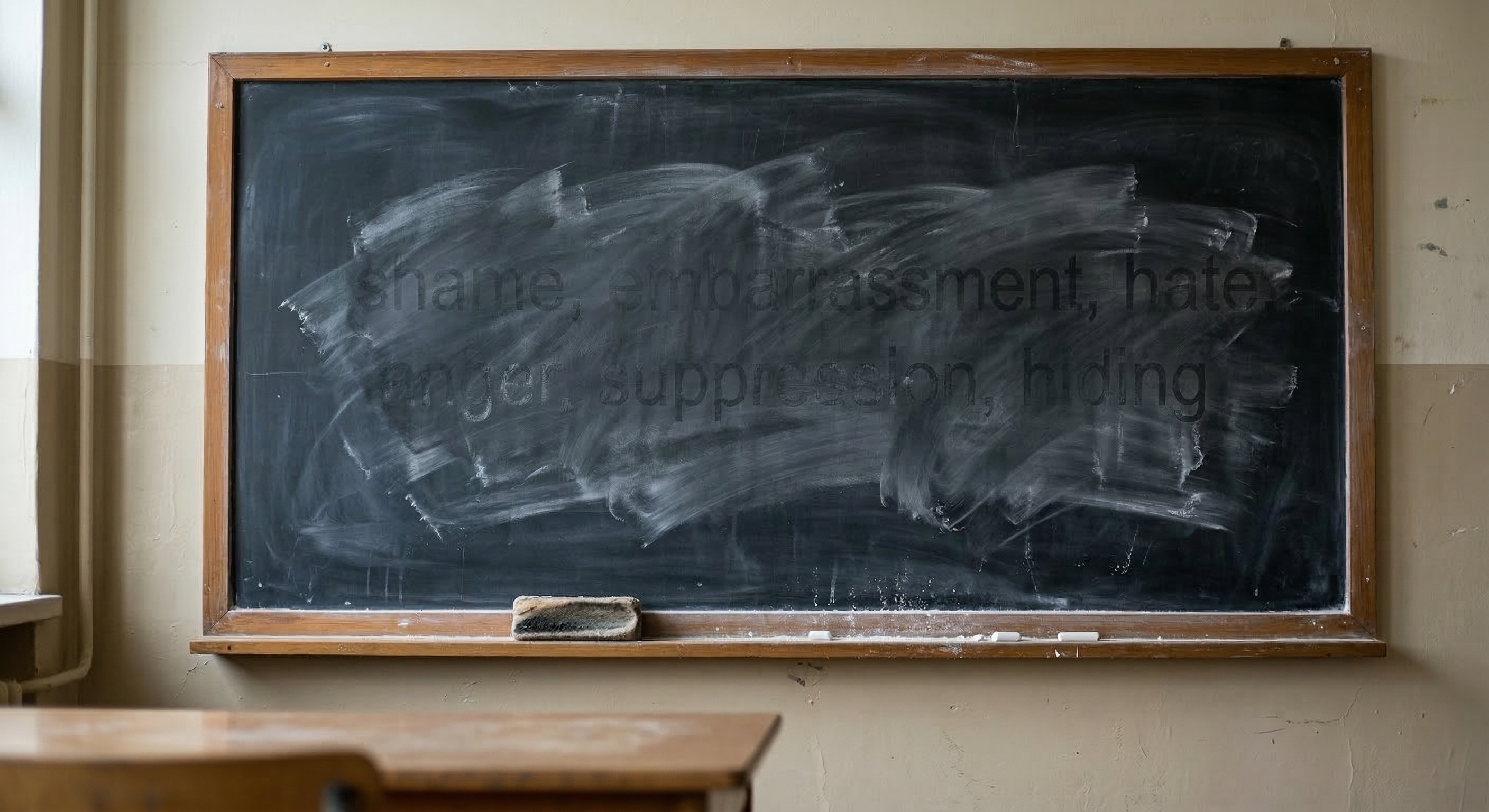
That's the blank slate. It was never about erasing the board until it's
perfect. Look at any chalkboard that's been wiped down — you can still see
the ghost of what was written there. The words are faded, but the residue
remains. Shame, embarrassment, hate, anger, suppression, hiding — they
leave marks. Forgiveness doesn't pretend those words were never written.
It clears the surface so you can write something new. The dust of what
was is still there. That's your story. And that story, friend, is worth
telling.
End of Entry 2 of 2